Pages

Monday, October 4, 2010

Sculpture and the Olso Opera House

Dutchbaby blog has a long photo filled post on the beautiful Operahuset or Opera House in Olso, Norway. The $800 million building opened in 2008 and was designed by Norwegian architecture firm, Snoehetta.    
photo from  The Doors of Perception. The lead architect is Kjetil Trædal Thorsen a partner in the Norwegian architectural firm Snøhetta.
The Operahuset is architecture as landscape. From a distance, across the water it resembles an iceberg and encourages viewer engagement by allowing people to walk all over the structure.

What I love is how well it plays with the different qualities of light on both the intimate micro-scale as well as the big picture. To see up close go to Dutchbaby.

Friday, October 1, 2010

Sculpture and Jason deCaires Taylor

Of his bones are coral made: Those pearls that were his eyes; Nothing of him that doth fade, But doth suffer a sea-change. Into something rich and strange." ... from Shakespear's the Tempest


I just received new photos of Jason deCaires Taylor's environmental sculpture. After 3 years under the sea in Grenadian waters he latest growth of sponges, tunicates, hydroids, soft and hard corals has been beyond all expectations.
all photos Jason deCaires Taylor

Initially, I had strong reservations about the work. Not his wanting to combine sculpture and environmental work, but the aesthetic of seeing figurative concrete sculptures underwater. 
I couldn't get the image of drowned bodies out of my mind. 
Context is everything.

But now that all the sculptures have suffered their sea changes, becoming mermen and mermaids and living reefs they are beautiful, strange and living instead of dead images. I guess " I've grown accustomed to her face...."


To see more of Jason deCaires Taylor's work click Here.

Wednesday, September 29, 2010

Sculpture and Kees Verkade

Ssshhhh!

The lovers are meeting.

Again.

Can you see them?
photography by Jacques Dirand
Where?
On the right. Up the stairs. In the trees.
Over there.
All photography by Jacques Dirand
The September Veranda magazine features a French country estate, "Chateau du Tertre." It's in the Bordeaux area.  Of course the focus is on the house, but the gardens and sculpture by Kees Verkade are what you should see.

The work is lovely. The siting of the work is brilliant.
It's wildly romantic as the context of the lovers will change with every season.
Mr. Verkade's intimate pair of lovers, "Invitation" is a short distance from the house, within sight but slightly removed, sited in a formally pruned grove of trees. Shown here in the height of spring/early summer.

Close your eyes and see them in the fall with the trees loosing their leaves. Now see them clearly, unsheltered, in the winter. The art is inspired, gentle and understated but formal setting lets nature and the garden do the heavy lifting. You can't see the art without also understanding the context of them meeting in "the woods". The mood of the art changes with each change of light and weather.

Another sculpture, a bathing figure, unattributed but possible by Verkade, is framed by a simple box hedge and anchors a long reflecting pool near the house.
Most of us do not have a chateau in France, but we can use good ideas in our own small gardens when siting sculpture.

Monday, September 27, 2010

Sculpture and the Garden

"It is necessary to cultivate our garden." from Candide by Voltaire
 

 "Gardens are the most complex art and the most rewarding. Art, science and nature are all connected. Exposing people to nature is such an important thing." Kulapat Yantrasast

I'm not sure where I found that quote by Yantrasast. He believes that gardens make people better. The quote is a perfect beginning for an ongoing Shadows On Stone series,  Sculpture and the Garden, where I'll be writing and thinking about the complex arrangement we call a garden.

Guilt bronze turtle at Aspet, Saint Gaudens studio.

Pan sculpture above the pool,  near Saint Gauden's studio
 

Detail of Pan sculpture, guilt bronze.
I'd love your input. Any books you can suggest, any images that embody this complex art of inanimate and living objects, relationships, and time. Your thoughts on the Why of sculpture and the garden would be welcome.

Friday, September 24, 2010

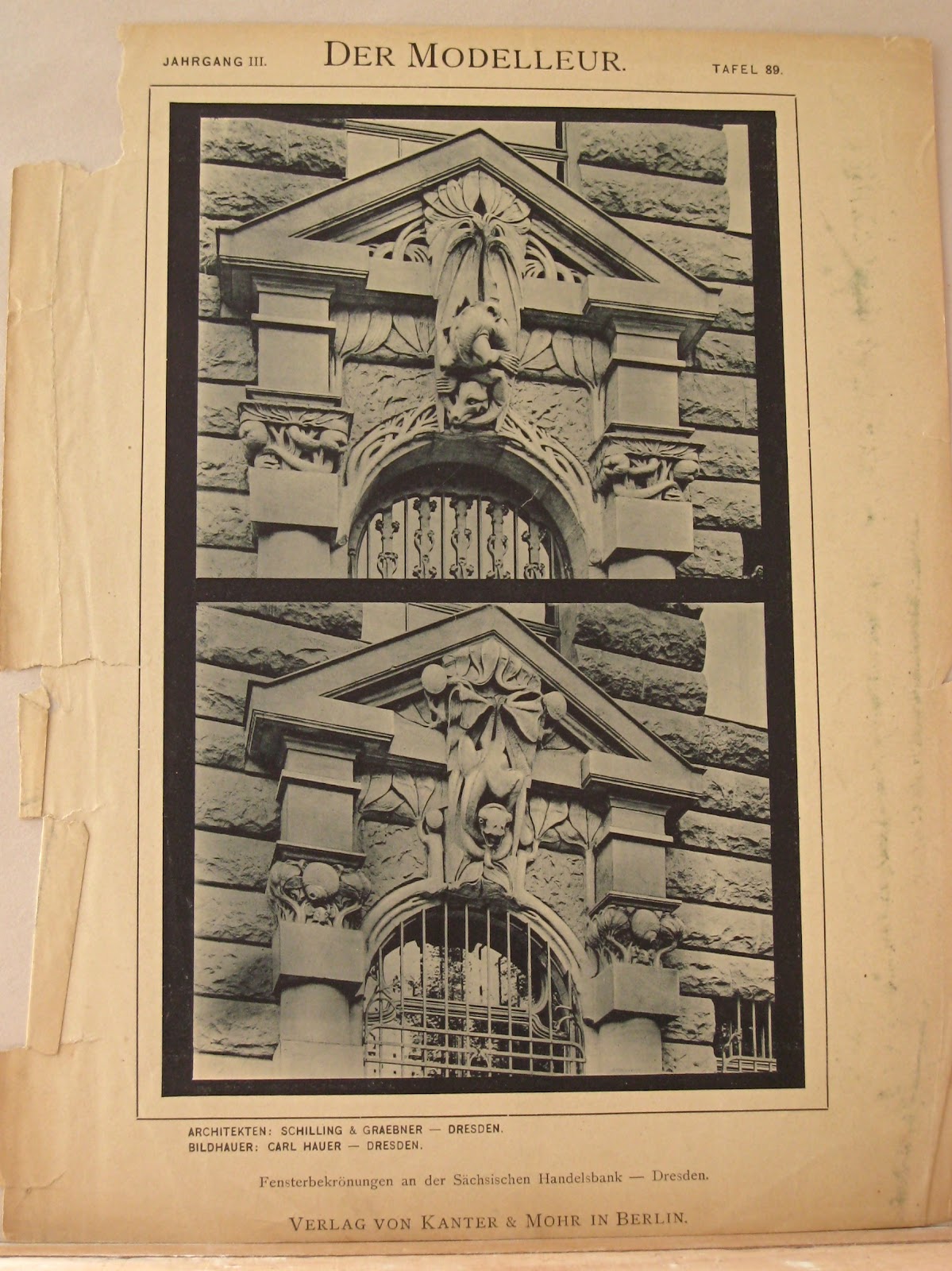
Sculpture and Der Modelleur

"Jackpot!"


Every page I looked at, "JACKPOT!!!!!!!!!!"


The book is a loose leaf architecture portfolio from 1905/1906 called Der Modelleure. The photos may not look impressive here, but click on them for an enlarged view. That photo above shows two larger than life sized dragons on the facade. Not for the faint of heart.....
Click on the image to better see the bizarre fish people.

These aren't small, they are entire facades of buildings!
 The buildings of early 20th Century Berlin and Dresden must have been absolutely hallucinogenic to see. Art Nouveau in full bloom. Not tepid Art Nouveau of fainting lilies either, these buildings crawling with dragons, medusa heads, etc are perfectly in synch with the challenging music of Richard Strauss' Salome.

These photos are a treasure trove of architectural ceramic building facades in Berlin and Dresden because they show the architectural clay models before they were cut into blocks and fired. Some of the photos show finished work, some are of works in progress. The photos show how they conceived and laid out the masses of clay.

Invaluable references for anyone involved in recreating and repairing the terra cotta facades of historic buildings. ... Or just wondering how they did it.....

The photos of these often enormous and beautifully detailed works also blow big holes through our contemporary notions of what "ceramic sculpture" can be, i.e. cute, small and crudely made.

I'll be featuring more images from this archive under the tag heading Der Modelleur.

Wednesday, September 22, 2010

Sculpture and Metropolis

The FUTURE is really old.

I just saw the restored version of Metropolis, the Complete Metropolis.


The complete Metropolis has restored scenes, found in film archives, edited out and unseen for decades.

Metropolis is wonderful on several levels. No pun intended, as the added sections make the plot more understandable. I'm amazed by the visuals of the segregated city of pleasure gardens and underground workers labyrinths. There are no "dance" sequences, but the movement of the workers changing shifts and at the clock are beautifully choreographed, and still very moving.

What I found interesting is how the present frames the past. Watching the heroine and children try to escape drowning by climbing the stairs made me think of the people in the twin towers escaping by descending the countless stairs in the dark. Context frames content.

Watching Metropolis is to see a bridge from the past to the future. Some of the acting (the hero and heroine) is stage, silent film, with  every emotion sold to the back row. Yet the understated father /villain is THE prototype for every cold, withdrawn intellectual ever since. Every film from Dr. Strangelove to Blade Runner owes an enormous debt to the creativity of the original. Go see Metropolis.

Monday, September 20, 2010

Sculpture and Plastic- Photographer Chris Jordan

Trash doesn't just disappear from our curbs to vanish from the earth. Well, maybe it does leave the earth, but only to appear in the oceans. Look at photographer Chris Jordan's Midway series.
Chris Jordan


Chris Jordan

Jordan says: "These photographs of albatross chicks were made in September, 2009, on Midway Atoll, a tiny stretch of sand and coral near the middle of the North Pacific. The nesting babies are fed bellies-full of plastic by their parents, who soar out over the vast polluted ocean collecting what looks to them like food to bring back to their young. On this diet of human trash, every year tens of thousands of albatross chicks die on Midway from starvation, toxicity, and choking.

To document this phenomenon as faithfully as possible, not a single piece of plastic in any of these photographs was moved, placed, manipulated, arranged, or altered in any way. These images depict the actual stomach contents of baby birds in one of the world's most remote marine sanctuaries, more than 2000 miles from the nearest continent." ~cj, Seattle, October 2009
 --------------------------------------------------------------------------------------------------------------------------
These images have haunted me. How do we live in our  throw away world without leaving piles of trash, sculptures of death everywhere?