Pages

Showing posts with label Nature. Show all posts

Wednesday, September 24, 2014

Sculpture and Rest

It's good to take a break from your work, though I'm taking my drawing pad and paints....
I'm off to the mountains at Breitenbush Hot Springs for much needed days of Rest and Rejuvenation.
 

Wednesday, June 25, 2014

Sculpture and Paul Stankard

Honeybees swarming a floral hive by Paul Stankard Photo by Ron Farina
It's one thing to see and appreciate beautiful work on its own merits. But hearing Paul Stankard talk about his glass sculpture, his influences and his goals makes his art so much richer.


"I am interested in integrating mysticism with botanical realism giving the glass organic credibility. Through the work, I reference the continuum of nature, by portraying and exploring the mysteries of seeds, fertility and decay. 
The work celebrates the primal beauty of nature on an intimate level.  It is influenced by the poetry of Walt Whitman."  


Tea Rose Bouquet with Mask by Paul Stankard. Photo by Ron Farina
Here's a short video on the artist. Interesting man at a sweet spot in his life.


His pieces now appear in over 60 museums around the world including the Smithsonian, the Metropolitan Museum of Art, and the Louvre.
See his work on his website, and in his book, Homage to Nature.


Monday, June 3, 2013

Sculpture and The Birds of Paradise

Who has any sense of a lion at the zoo?

That's true of these birds of paradise too.
You may have seen a photo, but until you've seen them move and radically change their shape, you have no idea of their beauty.


What would it be like if humans could change their shape as radically as these birds?

Wednesday, November 28, 2012

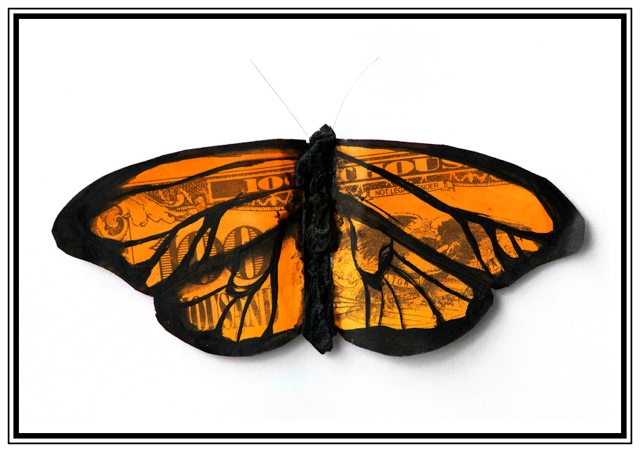
Sculpture and Vegan Lepidoptry

Sonja Bales is a 14 year old artist. She calls this series, "Vegan Lepidoptry." 
 After carefully study of real insects, Sonja takes her art beyond mimicry, using maps, currency,  
old text books, and decorative papers and plastic to make these new creatures. 

Sonja's work speaks to the different roles insects have in our culture: as exotic objects of beauty, 
as fragile migratory species, and as dream images....

George by Sonja Bales ©2012 used with permission of artist
Sonja says of her work, "My interest in butterflies was ignited after watching television on antique Lepidoptry (preservation of butterflies and bugs). They would poison the insect and stab it with a pin.

Terrible. 


I decided to make a vegan butterfly using plastic, but was not content with the result. I turned to paper.  I felt the butterflies needed to be carefully paired with each swatch of paper.

I'm an impulsive artist, and once something's done, there's always plenty more to beautify."


Sonja Bales ©2012 used with permission of artist
Sonja Bales ©2012


Monday, July 30, 2012

Sculpture and Biophilic Design

I've been reading the book, Biophilic Design, the Theory, Science, and Practice of Bringing Buildings to Life"  and found this amazing video, Patterned by Nature.


The 90 foot long sculpture uses low resolution patterns to bring a sense of the natural world into the Nature Research Center at the North Carolina Museum of Natural Sciences.
Read about the sculpture here

Thursday, November 17, 2011

Sculplture and Murmuration

How do you understand enormous changing forms made of living creatures?

Murmuration from Sophie Windsor Clive on Vimeo.
You don't. You just watch in awe.

A mumuration is a gathering of starlings.
---------------------------------------------------------------
PS. It's amazing how quickly interesting information can spread. After writing this post, I've been sent emails, facebooks, etc containing this video. If you've already seen it, watch it in the context of sculpture rather than nature.  What other than living organisms could create sculpture that constantly changes shape?

Tuesday, November 8, 2011

Sculpture and a Shadows On Stone Postcard

Shadows On Stone received a digital postcard from wood artist, John Casteline. John's blog on all things wooden is The Old Saw.

Photo by John Casteline ©2011
John and his wife were walking in the woods of Cook State Park, Pennsylvania. John saw this image, thought of my blog title and sent the photo to me. Thank you, John.

When I began blogging I wanted a title that combined art and poetry. Shadows On Stone, evokes that moment when the ephemeral meets the eternal.

Like John's photo, it's like seeing a slowly moving shadow on a rock that been there for centuries. That moment is about the awareness of being alive, feeling both time passing and time standing still. 

Kairos rather than Chronos.

Kairos (καιρός) is an Greek word meaning the right or opportune moment (the supreme moment). The ancient Greeks had two words for time, chronos and kairos. While Chronos refers to chronological time, Kairos signifies a time in between, a moment of indeterminate time in which something special happens.
 
In our busy world, it's important that know and practice the difference. Cultivating our sense of Kairos allows us to make space for and appreciate the special moments in our lives....
and boys and girls, that's where art comes from.....

Tuesday, July 19, 2011

Sculpture and Whales

Sculpture won't mean much if the world is bereft of wonder.

Two of the most moving primeval experiences of nature I've ever experienced are watching lava boil into the sea in Hawaii and seeing the whales and dolphins off Cape Cod.

Here is a successful rescue of a young whale entrapped in a net by members of Earth Island Institute.


Post script: When I write I try to have some sort of flow to the week, always with the focus on sculpture. What link between Janet Echelman's work and this wildlife rescue?

I just realized that the thread is the fish netting. It's both wildlife hazard and a new sculpture medium.

Monday, July 4, 2011

Sculpture and Jason deCaires Taylor

 Jason deCaires Taylor has a new sculpture, called Anthropocene.  It's located at the Manchones Reef, in Cancun/ Isla Mujeres, Mexico at a depth of 8 meters.

Anthropocene by deCaires Taylor. all photos from the artist.
A life size 8 ton cement replica of the classic Volkswagon beetle. The sculpture is designed specifically to house marine life whilst exploring the significant impact humans have had on our planets ecosystems and the subsequent affects to future generations. The VW beetle or "votcho" as it is known in Mexico is an iconic symbol and the classic shape was still in production until March 2003. Its rounded aerodynamic shape makes it perfectly suited to maintain stability underwater from strong currents and tropical storms.
More of his work.here


Friday, July 1, 2011

Sculpture and Jason deCaires Taylor

The sculpture of Jason deCaires Taylor only gets better with time.

In fact, time changes it completely. That's the point of his work. His art is a collaboration with nature.


I've written about his work here and here.

Monday, April 4, 2011

Sculpture and Art in the Garden

It's not just what you got.
It's how and where and why you put it.

Small sculpture in the flower gardens at the Saint Gaudens Estate 

It being sculpture in the garden.

I'll be talking about sculpture and the garden at the Association of Northwest Landscape Designers meeting tonight.

ANLD April Meeting: Art in the Garden

where: 15800 SW Hall Blvd, Tigard OR 97224
From : Monday, Apr 4, 2011 - 6:30pm to 9:00pm

Join Patrick Gracewood (Gracewood Studio), sculptor, as he shares his perspective about placing art in the garden to its greatest advantage. In addition to this brief presentation, Patrick and four other artists will share with us their work and creative process. Please join Patrick, Katy McFadden (ceramic figurative artist), Peter Andrusko (artisan stonework), Chris Moench (ceramic prayer wheels), and Keith Yurdana (metal fabrication) for an evening of artistic inspiration.

Monday, March 28, 2011

Sculpture and Home

It goes against the stereotype of the chaotic artist, but in order to create, my life needs to be pretty quiet. Dare I say it? Even boring.

Academy Award nominated filmaker, Courtney Hunt talks elequently about how her home in East Chatham, NY. preserves and fosters her creativity.

“My mind is a very busy place, so I need to be in a place that is not. 

I love the wide-open spaces here. They make me feel clear, as if I have more room to think. 

Right now I’m working on a project for Focus Features and sometimes I find myself sitting at the window, just watching. It’s like a movie: always in motion. A squirrel darts across the yard. The mail carrier passes. A rabbit emerges. And always, the change in seasons provides a constant show. 

We don’t watch a lot of TV here but during big rainstorms we’ve watched little tree frogs drop to the ground. And during snow storms, we’ve observed the white as it gathers, layer upon layer, all around us. This kind of quiet is hard to describe. As is a star-filled sky. The other night I was awakened by the sound of a hooting owl. This is not the city."

Interviewed by Bethany Lyttle from the NYTimes article, House Tour: East Chatham, NY. 3/24/2011.

Friday, March 19, 2010

Sculpture and MIMEtoLITHS


Multi-media artist conjures up computers and film and conceptual work. Algis Kemezys is a Montreal, Canada based multimedia artist whose media includes the oldest material on earth, stone. He has created numerous stackings he calls Self-Portraits in Stone.

Stacking stone is one of the oldest artistic expressions and still one of the most satisfying. From trail markers to grave cairns, stone is always environmentally sound and site specific. Working directly with available stone speaks directly to our atavistic origins. Algis says "Rock can certainly call out to you and when responding to this the message the results of working with it are magical."


All photos by Kemezys

Kemezys writes, "For me, the idea is an amalgam of sculpture and nature. Whenever I find an inspiring view I compose and build a complementary stone sculpture and photograph it. It becomes a part of me that I leave behind, but just like myself the artifact is impermanent. I use no cementing material and so my sculptures are ephemeral, succumbing to the elements and soon enough crumble to become again part of the landscape.

Most of these sculptures were made in Greece on the island of Crete and on the island of Rhodes. A few were made in southern Turkey as well."

His blog is MIMEtoLITHS
The movie he made of the stone sculptures is available on Amazon.
View the trailer here.

Friday, October 30, 2009

Sculpture and Snakes


Snakes are a common theme in folk art as canes, and as powerful images. Here's a little something for the Halloween soapbox.

Here are two of my snakes. (If you can't find it, you've just goota make it yourself.) The first two shots are of a snake I made from a cedar root. I only added one tooth and the eyes. Last photo is of the dreaded Wisteria Spiral Snake. When I found it in the trash, I couldn't believe that anyone could throw away something so cool. The vine wrapped around a column for multiple 360s. Brought it home and added checkers for the eyes, carved the mouth, added the tail and Voila! Folk Art

What isn't cool is when people take their "little" pet reptiles after they've grown too large for their cages and dump them in the wild. Florida is just waking up to the problem. The US Geological Survey released a report saying that 5 giant non-native species, boa constrictors, anacondas and pythons pose a high risk to wildlife. (Notice they didn't say pose a risk to humans. .. ... ... yet)

Read the chilling article if you can find it by Burkhard Bilger, titled "Swamp Things" in the New Yorker April 20, 2009, page 80. It's amazing what we do out of desire and ignorance. "It's pretty, it's cool, it's bad!" It is an exotic animal and what happens to it when we can no longer care for it in captivity? The answers aren't pretty.

Here's a link to the abstract

The article focuses on Burmese pythons, which are now breeding in Florida. They mature and reproduce quickly and will eat anything. Burmese implies tropical but researchers have found that the species native habitat reaches up to the Himaylias. That means the python’s potential range is roughly a third of the contiguous United States. Yikes!

Think about a 6 foot alligator, how strong it is, then click on this Youtube to see how well it fared with a 13 foot python. Remember that pythons can grow to be over 20 long. Happy Halloween.