Pages

Wednesday, September 19, 2012

Sculpture and Color

We returned from vacation to find a note on the front door.
A neighbor asking us for the colors of our newly painted house.  All of them.

Our house is a 102 year old Portland four-square. We wanted a color scheme that was elegant and did the old girl justice. She looks great but it came about only after hours of fierce debates over barely perceptual differences between colors like "Swan's Bottom" and "September Lingere".

Parts of the building looked like the fan deck. The only way to really know if a color works is to paint at least four square feet on the house. Each color block also requires trim and accent color to see how they all work together, because it's not only about color, it's about proportion.

Part of me knows that on another street, on another house, with different proportions, different lighting and landscaping, our three colors will look very different.

Cut to the question, do I give neighbor the info? Or do I tell them that we worked hard for this result and wish them joy in finding the perfect colors for their own house?
I believe in sharing information, but I hate giving my work away.

What would you recommend?
--------------------------
Update
Note to self: Scarcity thinking and fear are very limiting.
Taking the time to really think about sharing the color information was worthwhile too.

I called and had a nice conversation with the neighbor. Worried about the house colors appearing down the street were needless as the house they're painting is in Seattle! They'd also decided on completely different colors. (Whew!)


Monday, September 17, 2012

Sculpture - Cliches and Color

It's hard to make art or see art in a tourist-town environment - nothing feels fresh.

Provincetown, MA. was (is?) an art colony. As with any place of natural beauty, creativity, and descending hoards of summer visitors, it can slide into wall to wall cliche. Boats, lobster pots, twee sailor themes, shells that aren't local, all are grist for endless T-shirt tourist marketing.

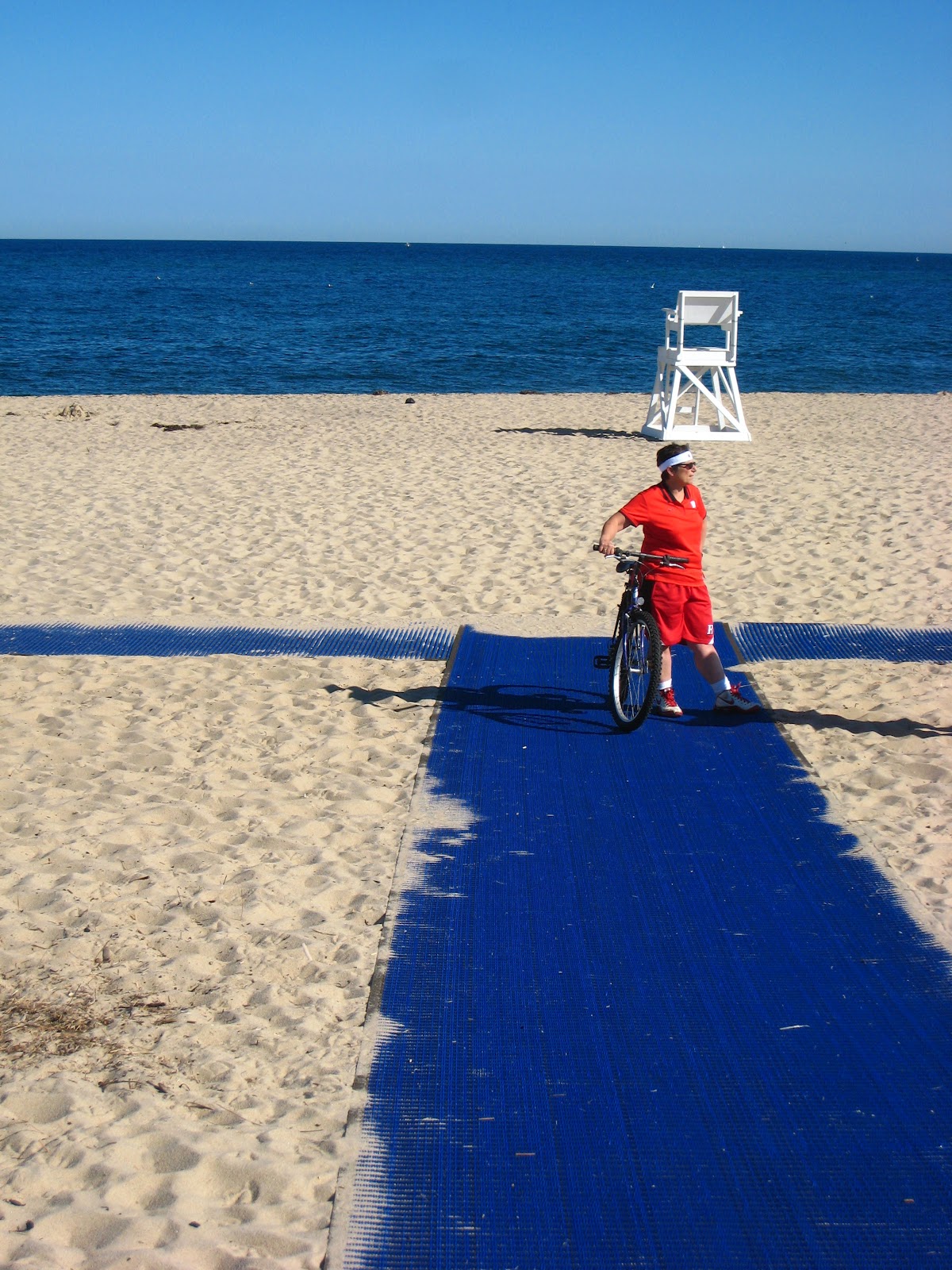
I stopped taking photos until these rivers of blue blew me away.
Seen from a quarter mile away, I had no idea what it could be.
Could this be an art instillation that makes me perceive the shore in a new way?


From a distance I had no idea what I was seeing. Could there a river on the sand?
Is the sea running uphill? Love that feeling of disorientation!
That much blue, intense blue, the same color as the ocean. WHAT IS IT?


The river of blue is a flexible surface that allows greater access to the beach for folks with disabilities. It's made by mobi-mat,
Composition in blue, red, and whites.
That this practical roadway is so beautiful on a sunny day is an aesthetic bonus.
                                                         ....wonder what it looks like in grey winter?


Wednesday, September 12, 2012

Sculpture and Context

After vacation, it's always fun to return to the studio and garden to find it full of naked ladies.


The bright pink flowers, Amaryilis belladonna, are like a chorus in front on my little lion carving,
...and suggest he's singing the song, from the movie the Wizard of Oz,  "If I only had the nerve."
 
"I'm afraid there's no denying 
I'm just a dandelion, 
a fate I don't deserve. 
But I could show my prowess, be a lion not a mouse,  if I only had the nerve."

Sculpture outdoors is seen to best advantage when you consider and establish as many relationships as possible between the art and the site. 

The lion, usually surrounded by tall blond grasses (Lion stalking or cat in the grass) now has an added twist of questionable courage from the late summer surround of pink flowers.


Monday, September 10, 2012

Sculpture and Scale

Sculpture is the most physical of the arts. It takes up space with its prescence and weight.
It also takes enormous physical effort and concentration from the sculptor.

Which is why I'm enjoying this extravagant little movie advertising Cartier.
It's dream-like raison d'etre is to seduce you with beauty. Glamour originally meant something beautiful but deadly, and the filmmakers play with the themes of adventure and danger. The idea being if you can afford Cartier, you're up for both because you're in total control.

What's worth noticing is how the scale of everything in this film is constantly changing. 
Is it jewelry sized or monumental?


How do you work with the scale of things in your life and art? Is bigger better, or does smaller draw you in?

Wednesday, September 5, 2012

Sculpture and Architectural Restoration

Here are both pieces finished. Good balance of light and shadow on the pine needles.

You can see it best on the left half of this sculpture. Look at the deepest part between the pine needles. You can see a clean channel. In the mold that will be smooth and strong.

For molding, what works well, is to have the everything release easily with as little undercut as possible. Silicon rubber is very strong and flexible, but you also need to design for the person who is un-molding the cast part. Too much of an undercut requires a lot of physical effort and wear and tear on the rubber mold.

Same here, look at the bottom channels and see that they are cleanly modeled. The last touch was to gently compress the surface with a flat block of wood. Done and delivered.

Will show more shots after they are molded, cast and installed.

Monday, September 3, 2012

Sculpture and Architectural Restoration

Successful architectural restorations depends on understanding the context for the sculpture.
How is it seen? What is the viewing angle?
This capital (photos) goes at the top of a street lamp, which means you are looking UP at it.
So the important aspects are the center and below. Only birds will see the above view,  that area must shed water easily, not retain it, but it doesn't need the same level of detail or finish.

The original concrete pine cone on the right is obviously hand modeled.
It has a good strong balance of light and dark. That's far more important for distance viewing than if the symmetry is perfect. Working up close, you can easily worry about the wrong things.

Here's the base form of the capital that I will model the swags of pine needles. You can see that all important center line. The drywall screws serve two functions, they anchor the clay onto the form. They also help me establish the depth of the relief. More in the next post.

Wednesday, August 29, 2012

Sculpture and Architectural Restoration

Everyone thinks of the arts as wild and free.
Everyone except artists, who know better. All of the arts require skills (work) and process (work).

Architectural restoration is technical sculpture.
It isn't about making anything up, rather it's how close can you get your object to match what was.
The pine cone roughed out. 

Here's the pine cone almost finished. Note the pencil center line and horizontal lines.
Paying attention to drawing and constantly referencing these can seem like a student exercise.
You know what? It's makes working faster and more concise.

Overall, it's got a good range of light to dark. Now to tighten it up and make every thing align.