Maiden Foundry was commissioned to create 4 over sized umbrellas for Providence Hospital in Portland, Oregon. They tried the high tec route only to discover that making their own maquettes was (once again) far more economical.
Read about the process on Pacific Northwest Sculptor's site
Monday, August 16, 2010
Friday, August 13, 2010
Sculpture and Ellen LeBow
Ellen LeBow is showing new work at Rice Polak in Provincetown, MA, August 13th - August 26th.
The good news is I'll be back east in time to see it! I've written about her work here.
The detail in her work is amazing. Click on either image to enlarge.
Here's what Rice Polak says about her new work: "Her latest body of work is a series black and white drawings executed in ink on clayboard. In this medium, the artist paints on special white board in ink and then scratches the drawing through the black, inked areas. LeBow’s recent imagery, is a radical departure from the Haitian focus of her past work. LeBow’s new, elongated panels attempt to depict the ecstatic, indiscriminate onslaught of life on time. Each one features the decent of a tumbling, cosmic cloud packed with characters “cannibalized,” she says, from personal and artistic influences. LeBow weaves a compressed assault of “divine messengers” that collapse time and space, threatening to at once overpower and exalt the earth-bound life below. As always, the results are stunning in their power and beauty of line.
The good news is I'll be back east in time to see it! I've written about her work here.
The detail in her work is amazing. Click on either image to enlarge.
Here's what Rice Polak says about her new work: "Her latest body of work is a series black and white drawings executed in ink on clayboard. In this medium, the artist paints on special white board in ink and then scratches the drawing through the black, inked areas. LeBow’s recent imagery, is a radical departure from the Haitian focus of her past work. LeBow’s new, elongated panels attempt to depict the ecstatic, indiscriminate onslaught of life on time. Each one features the decent of a tumbling, cosmic cloud packed with characters “cannibalized,” she says, from personal and artistic influences. LeBow weaves a compressed assault of “divine messengers” that collapse time and space, threatening to at once overpower and exalt the earth-bound life below. As always, the results are stunning in their power and beauty of line.
Labels:
Artist Spotlight
Wednesday, August 11, 2010
Sculpture and Ruth Moilliet
Half of the fun of blogging is discovering other artists, and then discovering the artists those artists are looking at. Stone Art blog's Sunny Wieler, had a post on British artist Ruth Moilliet's botanically inspired sculpture.
Most of the art about flowers is by painters, in thrall to color. Sculptors see beyond color to see the beautiful forms and shapes of plants.
Ruth wrote me and said "I love studying nature and plant forms for my work. Just moved onto studying pollination and co habitation as we seem to be loosing our bees in the UK at the moment thanks to the lack of wildflowers so always good to draw attention to issues."
Ruth Moilliet sculpture is so engaging because it has a child's sense of perspective and magic and a master's sense of proportion and craft. To view her website, click here
She sent this photo of her recent work called Pollination Sphere.
All photos below are from Ms. Moilliet's website and used with the artist's permission.
I'd have a hard time choosing between these next two sculptures.... Which of her work do you like?
Most of the art about flowers is by painters, in thrall to color. Sculptors see beyond color to see the beautiful forms and shapes of plants.
Ruth wrote me and said "I love studying nature and plant forms for my work. Just moved onto studying pollination and co habitation as we seem to be loosing our bees in the UK at the moment thanks to the lack of wildflowers so always good to draw attention to issues."
Ruth Moilliet sculpture is so engaging because it has a child's sense of perspective and magic and a master's sense of proportion and craft. To view her website, click here
She sent this photo of her recent work called Pollination Sphere.
All photos below are from Ms. Moilliet's website and used with the artist's permission.
Wildflowers Stainless steel, acrylic 30cm-2m
Passiflora, Stainless steel, 1.5m diameter
I'd have a hard time choosing between these next two sculptures.... Which of her work do you like?
Cardoon Parachutes, Stainless steel w2m H1/5m
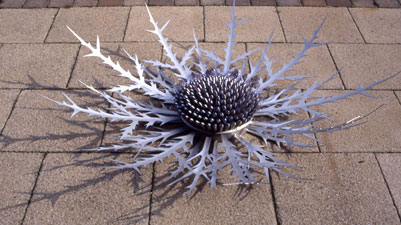
Eryngium , stainless steel, 1.5m diameter
Labels:
Artist Spotlight
Monday, August 9, 2010
Sculpture and Eckhard Völcker
This is NOT a pebble mosaic.
Though it may inspire you to create one.
I found this on Botany Photo of the Day.
They look like they're from outer space, but they come from the world of micro photography
This is a 10x magnification of a cross-sectioned pedicel of a rose. A microtome machine cuts very thin slices which are mounted on microscope slides and stained with a different dyes. Different tissues react to different dyes to produce these clearly defined micro-photographs.
The scientist/artist is Eckhard Völcker of Berlin. His website is Die Wunderkanone. The images, while scientific, are also very beautiful. Mandalas of living cells. Go see them.
Labels:
Artist Spotlight,
Craft
Friday, August 6, 2010
Sculpture and Paper Cuts
In the bright summer light, the shadow is as real as my paper cut artwork.
But when I saw this new black stencil graffitti a few blocks from the house, I looked for the little girl and her balloons. All that was left was her shadow.......
I hate grafitti's ugly tagging, but I do love a good, clever stencil....
But when I saw this new black stencil graffitti a few blocks from the house, I looked for the little girl and her balloons. All that was left was her shadow.......
I hate grafitti's ugly tagging, but I do love a good, clever stencil....
Labels:
Folk Art
Wednesday, August 4, 2010
Sculpture and Nelson Lau
Nelson Lau is an Australian based photographer. His website, Looking Glass Photography, has great photos of the 5th annual Sculpture By The Sea exhibition at Cottesloe Beach, Perth, in western Australia.
Be sure to see the sculpture of the giant watch "lost" in the sand. Lau's delightful photos of the sculpture are all the more amazing when you realize he's shooting in midday brilliant sunlight. To see more of Nelson Lau's photography click here.
(I'd show you more but was unable to transfer them. Above photo by Nelson Lau, used with the artist's permission.)
The sculptors and artwork are all unattributed, unfortunately, but some research on Sculpture By The Sea's website should remedy that.
Labels:
Artist Spotlight
Monday, August 2, 2010
Sculpture and Jeanette Winterson
I've praised Jeanette Winterson's book "Art Objects".
If you haven't read it, please do. It's marvelous thinking and writing. She'll reintroduce you to other brilliant writers like Gertrude Stein and Virginia Wolf.
Since it seems I'm in a manifesto mood, here's another brilliant essay by Jeanette Winterson.
It's one to mail to a friend, or better yet, read out loud to yourself.
Life is about relationship – to each other – and to the material world. Making something is a relationship.
The verb is the clue. We make love, we make babies, we make dinner, we make sense, we make a difference, we make it up, we make it new….
True, we sometimes make a mess, but creativity never was a factory finish.
The wrestle with material isn’t about subduing; it is about making a third thing that didn’t exist before. The raw material was there, and you were there, but the relationship that happens between maker and material allows the finished piece to be what it is. And that allows a further relationship to develop between the piece and the viewer or the buyer.
Both relationships are in every way different from mass production or store bought objects that, however useful, are dead on arrival. Anyone who makes something finds its life, whether it’s Michelangelo releasing David from twenty tons of Carrera marble, or potter Jane Cox spinning me a plate using the power of her shoulders, the sureness of her hands, the concentration of her mind.
I have a set of silverware made by an eighteenth century silverworker called Hester Bateman, one of the very few women working in flatware at that time. When I eat with her spoons, I feel the work and the satisfaction that went into making them – the handle and bowl are in equal balance – and I feel a part of time as it really is – not chopped into little bits, but continuous. She made this beautiful thing, it’s still here, and I am here too, writing my books, eating my soup, two women making things across time. I feel connection, respect, delight. And it is just a spoon…
But the thing about craft, about the making of everyday objects that we can have around us, about the making of objects that are beautiful and/or useful, is that our everyday life is enriched.
How it is enriched? To make something is to be both conscious and concentrated – it is a fully alert state, but not one of anxious hyper-arousal. We all know the flow we feel when we are absorbed in what we do. I find that by having a few things around me that have been made by someone’s hand and eye and imagination working together, I am prevented from passing through my daily life in a kind of blur. I have to notice what is in front of me – the table, the vase, the hand-blocked curtains, the thumb prints in the sculpture, the lettering block. I have some lamps made by Marianna Kennedy, and what I switch on is not a bulb on a stem; it is her sense of light.
So I am in relationship to the object and in relationship to the maker. This allows me to escape from the anonymity and clutter of the way we live now. Instead of surrounding myself with lots of things I hardly notice, I have a few things that also seem to notice me. No doubt this is a fantasy – but…
The life of objects is a strange one.
A maker creates something like a fossil record. She or he is imprinted in the piece. We know that energy is never lost, only that it changes its form, and it seems to me that the maker shape-shifts her/himself into the object. That is why it remains a living thing.
Of course it is possible to design an object that will be made by others – but that is an extension of the creative relationship, not its antithesis. It is the ceaseless reproduction of meaningless objects that kills creativity for all of us, as producers and consumers.
But are producers and consumers who we want to be?
To make is to do. It is an active verb. Creativity is present in every child ever born. Kids love making things. There are different doses and dilutions of creativity, and the force is much stronger in some than in others – but it is there for all of us, and should never have been separated off from life into art.
I would like to live in a creative continuum that runs from the child’s drawing on the fridge to Lucien Freud, from the coffee cups made by a young ceramicist to Grayson Perry’s pots.
We don’t need to agonise over the boundaries between ‘art’ and ‘craft’, any more than we should be separating art and life. The boundary is between the creative exuberance of being human, and the monotony of an existence dependent on mass production – objects, food, values, aspirations.
Making is personal. Making is shared. Making is a celebration of who we are."
Jeanette Winterson
If you haven't read it, please do. It's marvelous thinking and writing. She'll reintroduce you to other brilliant writers like Gertrude Stein and Virginia Wolf.
Since it seems I'm in a manifesto mood, here's another brilliant essay by Jeanette Winterson.
It's one to mail to a friend, or better yet, read out loud to yourself.
-------------------------------------------------------------
"The most satisfying thing a human being can do – and the sexiest – is to make something.Life is about relationship – to each other – and to the material world. Making something is a relationship.
The verb is the clue. We make love, we make babies, we make dinner, we make sense, we make a difference, we make it up, we make it new….
True, we sometimes make a mess, but creativity never was a factory finish.
The wrestle with material isn’t about subduing; it is about making a third thing that didn’t exist before. The raw material was there, and you were there, but the relationship that happens between maker and material allows the finished piece to be what it is. And that allows a further relationship to develop between the piece and the viewer or the buyer.
Both relationships are in every way different from mass production or store bought objects that, however useful, are dead on arrival. Anyone who makes something finds its life, whether it’s Michelangelo releasing David from twenty tons of Carrera marble, or potter Jane Cox spinning me a plate using the power of her shoulders, the sureness of her hands, the concentration of her mind.
I have a set of silverware made by an eighteenth century silverworker called Hester Bateman, one of the very few women working in flatware at that time. When I eat with her spoons, I feel the work and the satisfaction that went into making them – the handle and bowl are in equal balance – and I feel a part of time as it really is – not chopped into little bits, but continuous. She made this beautiful thing, it’s still here, and I am here too, writing my books, eating my soup, two women making things across time. I feel connection, respect, delight. And it is just a spoon…
But the thing about craft, about the making of everyday objects that we can have around us, about the making of objects that are beautiful and/or useful, is that our everyday life is enriched.
How it is enriched? To make something is to be both conscious and concentrated – it is a fully alert state, but not one of anxious hyper-arousal. We all know the flow we feel when we are absorbed in what we do. I find that by having a few things around me that have been made by someone’s hand and eye and imagination working together, I am prevented from passing through my daily life in a kind of blur. I have to notice what is in front of me – the table, the vase, the hand-blocked curtains, the thumb prints in the sculpture, the lettering block. I have some lamps made by Marianna Kennedy, and what I switch on is not a bulb on a stem; it is her sense of light.
So I am in relationship to the object and in relationship to the maker. This allows me to escape from the anonymity and clutter of the way we live now. Instead of surrounding myself with lots of things I hardly notice, I have a few things that also seem to notice me. No doubt this is a fantasy – but…
The life of objects is a strange one.
A maker creates something like a fossil record. She or he is imprinted in the piece. We know that energy is never lost, only that it changes its form, and it seems to me that the maker shape-shifts her/himself into the object. That is why it remains a living thing.
Of course it is possible to design an object that will be made by others – but that is an extension of the creative relationship, not its antithesis. It is the ceaseless reproduction of meaningless objects that kills creativity for all of us, as producers and consumers.
But are producers and consumers who we want to be?
To make is to do. It is an active verb. Creativity is present in every child ever born. Kids love making things. There are different doses and dilutions of creativity, and the force is much stronger in some than in others – but it is there for all of us, and should never have been separated off from life into art.
I would like to live in a creative continuum that runs from the child’s drawing on the fridge to Lucien Freud, from the coffee cups made by a young ceramicist to Grayson Perry’s pots.
We don’t need to agonise over the boundaries between ‘art’ and ‘craft’, any more than we should be separating art and life. The boundary is between the creative exuberance of being human, and the monotony of an existence dependent on mass production – objects, food, values, aspirations.
Making is personal. Making is shared. Making is a celebration of who we are."
Jeanette Winterson
Labels:
Artist Spotlight,
Philosophical Context
Subscribe to:
Posts (Atom)